
A flickering grid and a silent refrigerator are the two loudest alarms in any household. The panic-buy of a cheap, open-frame screamer that sips oil and spews noise is a mistake most homeowners make exactly once. The right affordable home generator matches your essential load profile, runs clean enough for a laptop, and stays quiet enough to not get you evicted from the neighborhood during a multi-day outage.
I’m Min — the co-founder and writer behind Gadgets Feed. I’ve spent hundreds of hours analyzing generator datasheets, decoding THD percentages, comparing decibel ratings, and cross-referencing real owner experiences across dozens of inverter and open-frame models to build a guide that spares you the research treadmill.
Whether you need a whisper-quiet inverter for RV trips, a dual-fuel workhorse that sits on a transfer switch, or a battery backup you can run indoors, this guide breaks down the real specs and real trade-offs behind every affordable home generator worth your money.
How To Choose The Best Affordable Home Generator
Selecting an affordable home generator is less about the sticker shock and more about matching output, fuel type, and portability to your actual emergency load. Here is the framework I use when evaluating every model.
Running Watts vs. Starting Watts
A refrigerator and a furnace both have startup surges that can trip a generator if you only look at running wattage. The rule of thumb: your generator’s starting (peak) wattage must cover the highest single motor surge plus the running load of everything else. Every review in this guide flags the peak-to-rated ratio.
Inverter vs. Conventional Open-Frame
Inverter generators produce cleaner power (THD under 3%), are noticeably quieter, and automatically adjust engine speed to match load — saving fuel. Open-frame conventional units are louder and heavier but deliver more raw wattage per dollar, making them ideal for transfer-switch whole-house backup where noise is less critical. Know your priority: clean and quiet, or raw capacity.
Dual Fuel: Gasoline vs. Propane
Propane stores indefinitely without degrading, burns cleaner, and eliminates carburetor gumming. Gasoline offers higher peak watts and is easier to find during a crisis. A dual-fuel generator gives you both options, and every model listed here with dual-fuel capability runs on LPG right out of the box with the included hose.
Runtime and Tank Size
Runtime at 25% load (fridge, lights, modem) is the real-world number that matters, not the optimistic spec at zero load. A generator with a 1.2-gallon tank might run a modest load for 4–5 hours, while a 6.6-gallon tank can stretch to 10–12 hours on the same load. Match your refueling tolerance to the outage duration you expect.
Noise Level (dBA)
In residential areas, noise ordinances often kick in after dark. An inverter generator rated at 52–62 dBA at 23 feet sounds like a conversation or a window AC unit. An open-frame unit pushing 75–82 dBA sounds like a lawnmower. If you need power while sleeping, prioritize the quietest inverter option.
Quick Comparison
On smaller screens, swipe sideways to see the full table.
| Model | Category | Best For | Key Spec | Amazon |
|---|---|---|---|---|
| Westinghouse 4000W Dual Fuel Inverter | Inverter | RV & Quiet Home Backup | 52 dBA noise level | Amazon |
| WEN DF8000X | Open Frame | Whole-House Transfer Switch | 8500W running (propane) | Amazon |
| PowerSmart 4400W Dual Fuel Inverter | Dual Fuel Inverter | Value Pick Gas/Propane | 11 hr runtime at 25% load | Amazon |
| ERAYAK 4500W Inverter | Inverter | Camping & Sensitive Electronics | 0.2% – 1.2% THD | Amazon |
| PowerSmart 3800W Inverter | Inverter | Lightweight Emergency Backup | 52 lbs & 59 dBA | Amazon |
| WEN DF360iX | Dual Fuel Inverter | RV with Fuel Flexibility | 49 lbs (lightest dual-fuel) | Amazon |
| Champion 4000W Dual Fuel Inverter | Dual Fuel Inverter | Extended Propane Runtime | 25 hr runtime on propane | Amazon |
| Anker SOLIX C2000 Gen 2 | Battery Power Station | Indoor Use & Solar Recharge | 2048 Wh LiFePO4 | Amazon |
| Westinghouse 12500W Dual Fuel | Open Frame | High-Output Whole House | 12500W peak (gasoline) | Amazon |
| AIVOLT 8000W Dual Fuel Inverter | Large Inverter | Quiet High-Capacity Backup | 62 dBA at 8000W peak | Amazon |
| EF ECOFLOW DELTA Pro | Battery Power Station | Maximum Indoor Backup | 3600 Wh expandable to 25 kWh | Amazon |
In‑Depth Reviews
1. Westinghouse 4000W Dual Fuel Portable Inverter Generator

The Westinghouse iGen4000DFc strikes an almost unfair balance: it delivers 4000 peak watts and 3300 rated watts from a dual-fuel inverter platform, yet operates at a claimed 52 dBA — quieter than a normal conversation. The 1.69-gallon tank yields up to 7 hours of runtime, and the Economy Mode automatically trims engine speed to save fuel when the load drops. For an RV owner or a homeowner who wants backup power without waking the street, this is the benchmark.
The remote start key fob is not a gimmick — it lets you fire up the generator from inside a dry cabin or house during a storm. The digital display cycles through fuel level, output wattage, remaining runtime, and voltage, giving you dashboard-level visibility that most sub- units lack. The telescoping handle and 62.8-pound weight make it genuinely portable for one person to roll across a lawn.
Real owner reports confirm it powers a 30A boat/cruiser AC, stove, fridge, and microwave simultaneously without bogging. The CO auto-shutdown sensor has proven responsive (one owner noted it detected boat exhaust). The only consistent critique: the remote start button on the key fob leaves the power switch in a state that can drain the battery if left on. A simple habit check solves this.
Why it’s great
- Whisper-quiet 52 dBA operation at 23 feet
- Dual-fuel gas/propane with included LPG hose
- Remote, electric, and recoil start options
- Rotating digital display with fuel level and runtime
Good to know
- Remote start key fob can drain battery if left in standby
- Noisier than 52 dBA claim under heavier loads per some users
2. Westinghouse 12500W Dual Fuel Home Backup Portable Generator

When your backup needs extend beyond a fridge and a few lights to a well pump, furnace, and an entire transfer-switch panel, the open-frame Westinghouse 12500W is where affordable whole-house power starts. This is a 212-pound brute powered by a 457cc 4-stroke OHV engine with a cast iron sleeve — the kind of construction that suggests longevity rather than throwaway emergency gear. On gasoline it delivers 9500 running watts and 12500 peak watts; on propane the figures drop slightly to 8500 running and 11200 peak, still enough to run most 240V appliances.
The 6.6-gallon fuel tank supports up to 12 hours of half-load runtime, and the electric start paired with a remote key fob means you can fire it up from the porch without standing over a pull cord in the rain. The outlet panel is transfer-switch ready with a L14-30R twist-lock and an RV-ready 14-50R 50A outlet. Owners routinely report running their entire house — including well pump, water heater, and multiple circuits — through a transfer switch with no issue.
Assembly is minimal (wheels, feet, battery) and the included tool kit and oil make it a fast out-of-box experience. Noise is definitely in the mower territory (around 75–82 dB), so this is not a neighbor-friendly, all-night solution without earplugs. A few owners noted that the CO sensor is present, and the unit meets EPA compliance, though some wished for an eco-mode switch that is absent on open-frame models.
Why it’s great
- Massive 12500W peak / 9500W running on gasoline
- Dual-fuel with included LPG hose
- Remote start key fob plus electric and recoil backup
- Cast iron sleeve engine for durability
Good to know
- Loud open-frame design (75–82 dB)
- No ECO or economy mode
- Weighs 212 lbs — needs a hand truck for uneven terrain
3. Anker SOLIX C2000 Gen 2 Portable Power Station
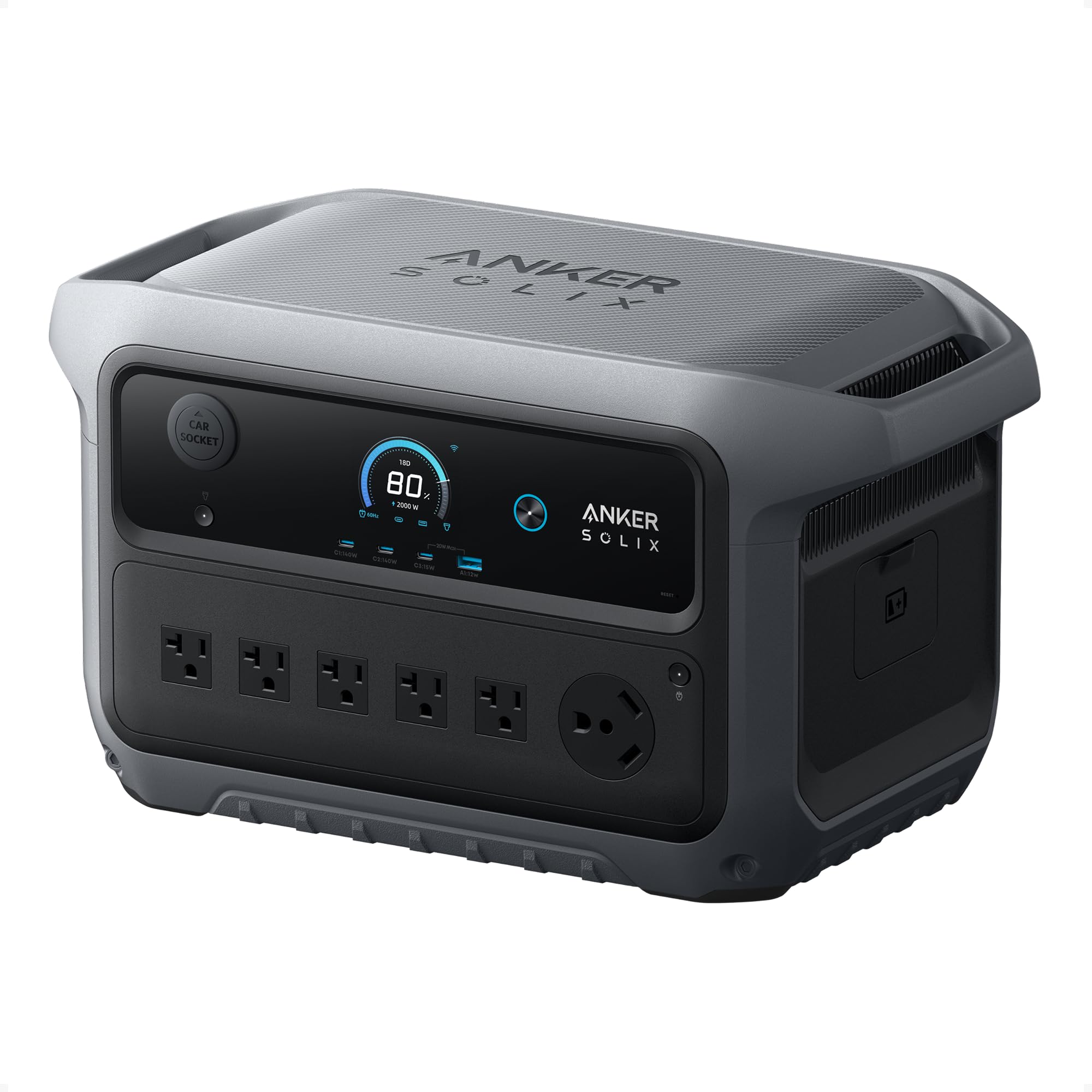
The Anker SOLIX C2000 Gen 2 is the future of affordable home backup for anyone who refuses to store gasoline or tolerate engine noise. Its 2048 Wh LiFePO4 battery produces 2400W rated output (4000W peak via SurgePad), which is enough to run a full-size fridge, a freezer, a TV, and a modem simultaneously for over 10 hours based on real owner feedback. The headline feature: a full recharge from 0–100% in just 58 minutes via standard AC — a speed that makes even the fastest gas generator refuel cycles feel slow.
The unit weighs 41.7 lbs and measures 18.1 x 9.8 x 10.1 inches, which is small enough to stash under a counter or in a closet. The six output ports include five 120V AC outlets, two USB-C (100W), USB-A, and a 12V car port, and the companion app provides real-time monitoring via Bluetooth and Wi-Fi. Owners particularly value the pass-through mode that switches to battery backup automatically on grid failure, and the ability to daisy-chain a second expansion battery to reach 4 kWh for multi-day outages.
Solar charging is supported but not included; paired with 800W alternator charging, the C2000 Gen 2 can reach full charge in 3 hours from a car. It is silent, emission-free, and safe for indoor use — a critical advantage over any combustion generator. The main trade-off: 2048 Wh covers essentials but not a whole house, and expansion batteries add cost. For urban apartment dwellers or suburban users with modest loads, this is the cleanest, most convenient emergency power solution at a premium-tier price.
Why it’s great
- Zero noise, zero fumes — safe for indoor use
- 58-minute full recharge from AC
- Compact 41.7 lbs and expandable to 4 kWh
- Automatic UPS-style pass-through backup
Good to know
- 2400W rated output may not start large well pumps
- Solar panels and expansion battery sold separately
4. PowerSmart 4400W Dual Fuel Portable Inverter Generator
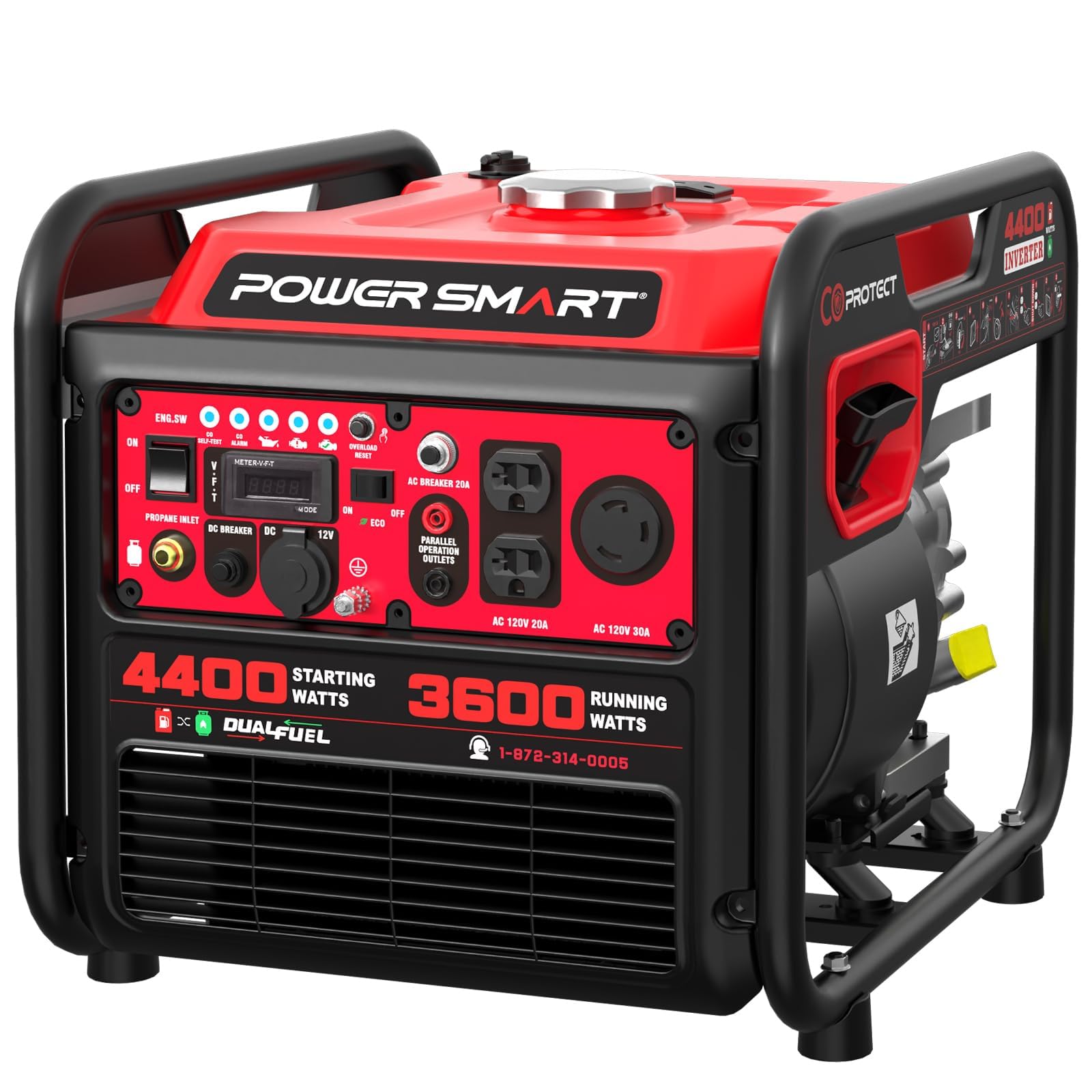
The PowerSmart MB5040DC punches above its price tier with a genuine dual-fuel inverter platform that produces 4400 starting watts and 3600 rated watts. The 1.6-gallon tank delivers an impressive 11 hours of runtime at 25% load, and the 76 dBA noise rating (at 23 feet, 25% load) is respectable for an inverter — quieter than an open-frame but not library-quiet. The 223cc 4-stroke OHV engine includes a CO sensor, low-oil shutdown, and overload protection, which are safety features that many sub- dual-fuel generators omit.
At 61.29 lbs dry, it is manageable for one person to wheel around, and the compact 16 x 16 x 19-inch footprint stows easily in a garage or truck bed. Owners report running their entire home via a 30A inlet box — everything except 240V appliances — and many highlight the fuel efficiency as a standout. The unit starts reliably after turning the fuel valve on and the ECO mode further decreases noise and consumption once the initial surge passes.
There is a small but notable quality-control risk: at least one verified owner received a unit with a defective main control module that would not start, and Amazon issued a full refund without requiring a return. This signals that while the engineering is solid for the price, batch variance exists. If you get a good unit, the value proposition is unmatched. The dual-fuel flexibility alone saves you from buying separate hoses or adapters.
Why it’s great
- Dual-fuel gas/propane right out of the box
- 11-hour runtime at 25% load
- CO sensor and overload protection included
- Lightweight and compact for an inverter
Good to know
- Quality control variance — some units arrive defective
- 76 dBA is quiet for open-frame but not whisper-quiet
5. ERAYAK 4500W Portable Inverter Generator

If you power medical devices, gaming consoles, or any sensitive electronics through your generator, the ERAYAK 4500W inverter deserves your attention for its exceptionally low THD of 0.2%–1.2% — significantly cleaner than the typical 3% claimed by most inverter models. It delivers 4500 peak watts and 3500 running watts from a 208cc 4-stroke engine, with a noise rating of 60.5 dB(A) at 23 feet before ECO mode kicks in. The weight stays at 55.12 lbs with compact dimensions (20 x 12.2 x 19.3 inches), making it one of the lightest portable inverters in the 3500-watt running class.
The outlet panel is unusually well-equipped for a unit at this price point: a 30A L5-30R RV receptacle, two standard 120V 20A household outlets, a 12V cigarette lighter port, plus both USB-A and USB-C ports. The 50A parallel-ready capability (sold separately) means you can link two units to reach 7000W rated power — a rare feature in the sub- category. Fuel consumption is a strong point: 0.21 gallons per hour at 25% load, and 0.561 gallons per hour at rated load.
Owner feedback is highly positive for construction quality and quietness, with contractors reporting it runs demolition hammers without bogging and RV owners praising its ability to power AC units silently. One caution: a verified owner experienced a total failure after ~350 hours (spark plug and oil change did not resolve). The 3-year warranty and US support hotline mitigate this risk, but long-term reliability is not yet proven by a large sample size.
Why it’s great
- Exceptionally clean power (0.2%–1.2% THD)
- Lightweight at 55 lbs with RV-ready outlets
- 50A parallel-ready capability
- Fuel-efficient at 0.21 gal/hr at 25% load
Good to know
- Some units reported failure after ~350 hours
- Electric start only on this model
6. PowerSmart 3800W Portable Inverter Generator
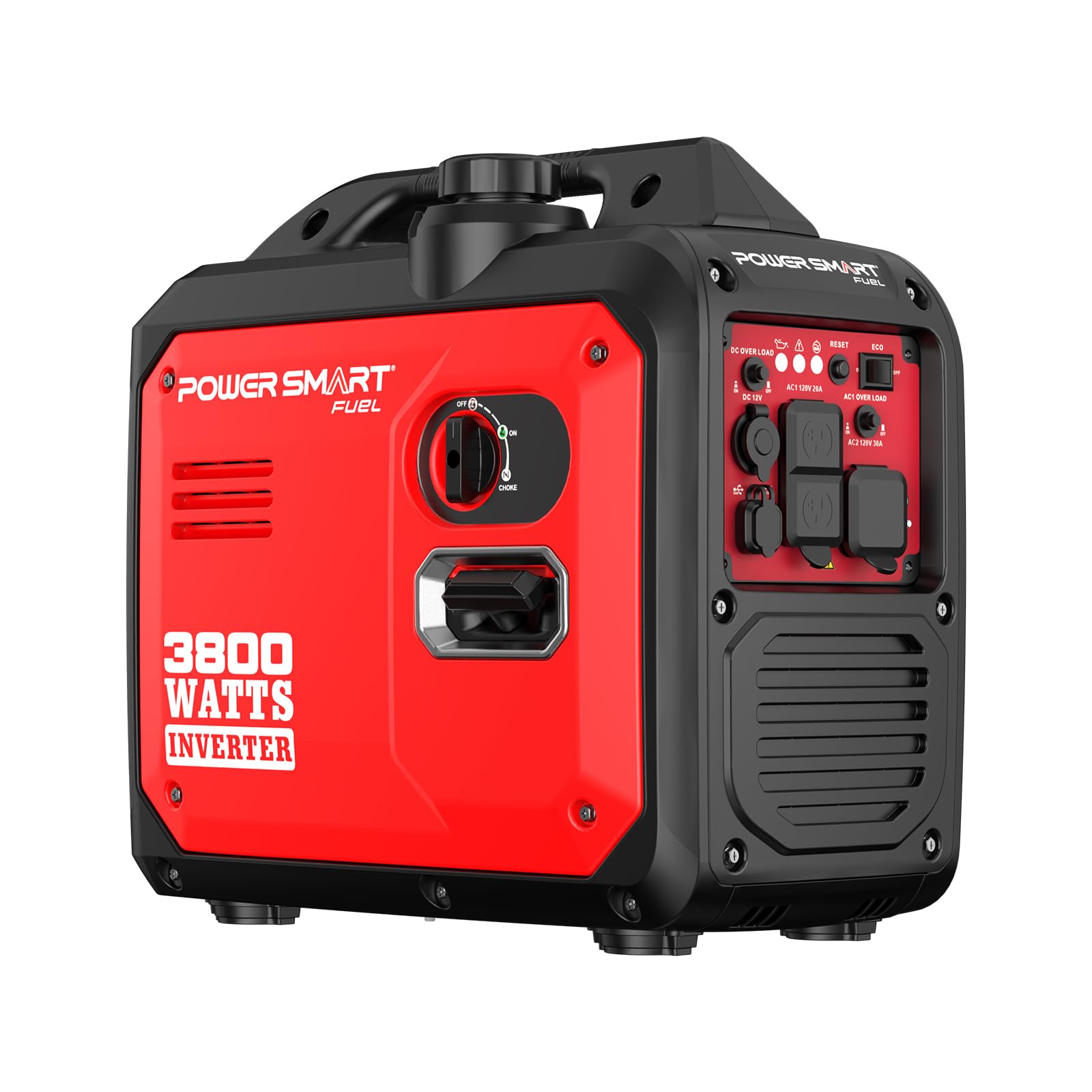
The PowerSmart DB5068 is the entry-level inverter that proves you do not need to spend a fortune for clean, quiet power. It generates 3800 starting watts and 3200 rated watts with less than 3% THD, making it safe for laptops and phones. The real standout is the 59 dBA noise rating at 23 feet — quieter than a normal conversation — which makes it a strong candidate for overnight use in RV parks or neighborhoods with noise restrictions. At 52 pounds with an ergonomic handle, it is genuinely portable for one person to lift into an SUV.
The 1.19-gallon fuel tank supplies up to 4.5 hours at 50% load, and the economy mode adjusts engine speed automatically to stretch runtime further. Outlets include two 120V 26.7A AC ports and a 5V USB port. The unit is parallel-ready, meaning you can link a second DB5068 to double output capacity (parallel kit sold separately). Owners consistently mention that it starts on the first pull straight out of the box, with zero assembly required, and that the carb drains cleanly on shutdown via the fuel shutoff.
I particularly appreciate the reported reliability from a remote off-grid user who runs this as their sole power source without issue. The only functional complaint is the 4.5-hour runtime at half load — shorter than some competitors with larger tanks — which means refueling more frequently during a long outage. For the price, however, the combination of light weight, quiet operation, and clean inverter power is hard to beat.
Why it’s great
- Very quiet 59 dBA operation
- Lightweight at 52 lbs with ergonomic handle
- Clean inverter power (under 3% THD)
- No assembly required out of the box
Good to know
- Only 4.5-hour runtime at half load
- Single fuel (gasoline only)
- USB output limited to 5V, not USB-C
7. WEN DF360iX Quiet and Lightweight Dual Fuel Inverter

The WEN DF360iX is the lightest dual-fuel inverter generator in this guide at just 49 pounds, yet it still delivers 3600 surge watts (gasoline) and 3500 surge watts (propane). The 149cc 4-stroke engine is rated for 2900 running watts on gas and 2600 on propane, which is enough to run an RV AC unit, a refrigerator, and a few lights simultaneously. The dual-fuel quick-connector for propane is tool-free and included — no extra hoses to buy — and the CO Watchdog sensor automatically shuts down the generator if dangerous carbon monoxide levels accumulate.
The control panel features a fuel gauge, a digital display showing volts, frequency, runtime, and load percentage, plus two standard 120V receptacles, one TT-30R RV outlet, one 12V DC port, and two USB ports. The information display is a rare find at this weight class and price point; it allows you to monitor real-time load, which helps prevent overload trips. Owners report that the unit starts on the first or second pull on both gas and propane, and that the overall assembly is neat with no oil leaks.
One consistent quality issue: the two 20A household outlets hold plugs loosely, which can cause nuisance disconnections for sensitive connections like a fridge. Additionally, the spark plug wrench in the tool kit is not clearly identified in the manual. The 3-year warranty and WEN’s customer service (which sent a free replacement regulator to one owner who received a damaged unit) add peace of mind. For its weight and dual-fuel capability, the DF360iX is the most backpackable RV companion in the list.
Why it’s great
- Ultra-lightweight at 49 lbs for a dual-fuel inverter
- CO Watchdog safety auto-shutdown
- Digital display with voltage, frequency, and load %
- Tool-free LPG quick-connect
Good to know
- 20A household outlets hold plugs loosely
- Toolkit documentation is sparse
8. Champion 4000W Dual Fuel RV Ready Portable Inverter Generator

The Champion 4000W dual-fuel inverter achieves an exceptional 25 hours of runtime on a standard 20 lb propane tank at 25% load — the longest propane runtime in this guide. On gasoline, the same unit runs up to 10 hours on its 1.6-gallon fuel tank. It delivers 4000 starting watts and 3000 running watts on gasoline, and 2700 running watts on propane with clean electricity under 3% THD. The 64 dBA noise rating at 23 feet keeps it within campground standards and residential tolerance.
The 149cc 4-stroke engine features Champion’s CO Shield auto-shutoff system, which meets the latest safety standards. The control panel includes a TT-30R 30A RV outlet, a 120V 20A household duplex outlet, a 12V automotive-style port, and parallel outlets. The optional parallel kit (sold separately) lets you pair with another Champion inverter to double output. Setup is straightforward: engine oil and a funnel are included, and the propane hose connects directly. Owners frequently praise the dual-fuel simplicity, noting that running on propane eliminates carburetor maintenance and the ethanol problems associated with stored gasoline.
The primary concern is reliability: two verified owners received defective units in succession — one failed after three weeks, the second after three months (white smoke and no power). Champion’s customer support was reportedly difficult to reach and did not honor the 24/7 support claim in one case. At 53 pounds, the unit is portable but not ultralight. For buyers who value long, maintenance-free propane runtime and are willing to accept the QC lottery, the Champion delivers unmatched fuel endurance.
Why it’s great
- 25-hour runtime on a 20 lb propane tank
- Dual-fuel with included LPG hose
- CO Shield auto-shutdown safety system
- Parallel-ready for power expansion
Good to know
- Quality control issues reported — some units defective
- Customer support availability inconsistent
- Not the quietest inverter at 64 dBA
9. EF ECOFLOW DELTA Pro Portable Power Station
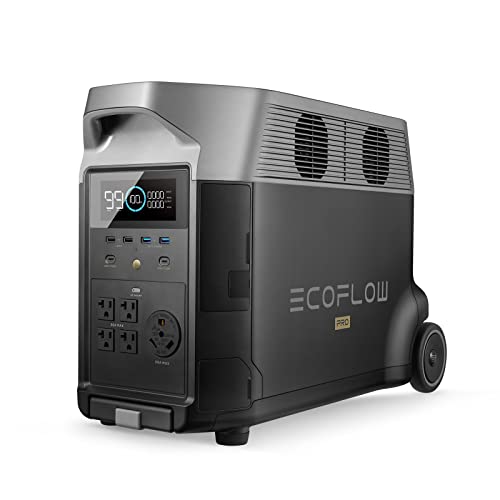
The base unit packs 3600 Wh of LiFePO4 capacity with a 3600W AC output (4500W via X-Boost), expandable up to 25 kWh with extra batteries and a smart generator. It recharges from a standard 1800W wall outlet in 2.7 hours, or from a 240V outlet in just 1.8 hours — far faster than any solar generator in its class. Owners report running two refrigerators, a freezer, a Keurig, an induction cooktop, and an air fryer for two full days with expansion batteries attached.
The unit weighs 99 pounds and measures 25 x 11.2 x 16.4 inches, which is more of a dolly-based move than a carry. Output options are extensive: five 120V AC outlets, two 100W USB-C ports, two USB-A fast charge ports, two DC outlets, a car power port, and an Anderson port. The app control via Wi-Fi or Bluetooth provides real-time monitoring, energy habit breakdown, and input/output customization. The pass-through mode automatically switches to battery in a grid failure, functioning as a whole-house UPS.
The X-Stream charging technology is genuinely fast — one owner noted it powers an oxygen concentrator for 10 hours 47 minutes on a single battery, providing total peace of mind for medical needs. The main barrier is the upfront cost. The base unit is the highest-priced entry on this list, and expansion batteries add substantial cost. For users who value silent, fume-free, scalable indoor backup and have the budget to build out the system, the DELTA Pro is the most capable stationary battery generator in the affordable range.
Why it’s great
- Expandable from 3.6 kWh to 25 kWh
- Fastest recharge: 1.8 hours via 240V
- Silent, emission-free indoor use
- App control for monitoring and customization
Good to know
- Heavy at 99 lbs — not truly portable
- High base cost; expansion batteries are expensive
10. WEN DF8000X Dual Fuel Portable Generator
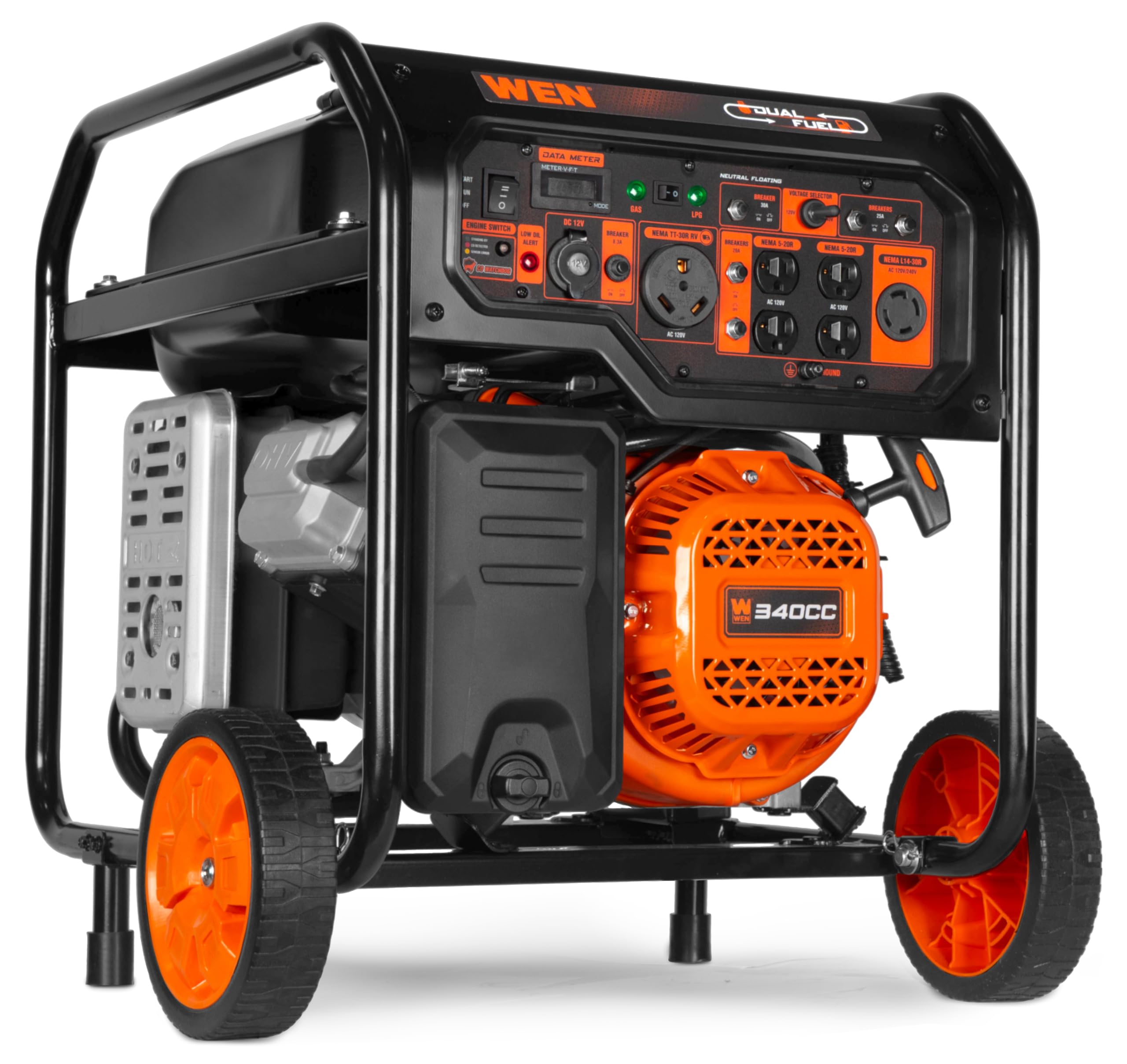
The WEN DF8000X delivers 8000 surge watts and 6500 running watts on gasoline (7200 surge / 5850 running on propane) via its 340cc 4-stroke engine, positioning it as the highest-output affordable open-frame unit before you reach the threshold. The electric start with push-button convenience eliminates the struggle of yanking a pull cord on a cold morning, and the 6.7-gallon fuel tank provides up to 10.5 hours of half-load runtime. The dual-fuel design includes a propane hose and regulator right in the box.
The outlet panel is well laid out for both home backup and RV use: four 5-20R 20A household outlets, one TT-30R 30A RV receptacle, one L14-30R 30A transfer-switch-ready twist-lock, and a 12V DC port. The included wheel kit makes the 130+ pound frame rollable on flat ground. Owners report running their entire house (excluding 240V appliances like dryers and water heaters) via a 30A inlet, and the generator is praised for its reliability during prolonged use. One owner logged an extraordinary 6000 hours of runtime before the motor failed, and WEN replaced the entire unit free of charge under warranty.
Noise level is in the open-frame lawnmower range (around 80 dB), so this is a backyard unit, not a camping companion. The pull start also works as a backup if the battery dies, and the engine has a cast iron sleeve for longevity. Minor complaints include the dipstick’s fine threads being prone to cross-threading and the rocker switch not actually shutting off the fuel — you must close the fuel valve. For those seeking a high-output dual-fuel generator with reliable American brand support, the DF8000X offers the best watts-per-dollar ratio in its class.
Why it’s great
- 8000W peak / 6500W running on gasoline
- Electric push-button start plus recoil backup
- Dual-fuel with included LPG hose
- Transfer-switch ready L14-30R outlet
Good to know
- Loud open-frame design (~80 dB)
- Dipstick threads prone to cross-threading
- Fuel valve must be closed manually for shutdown
11. AIVOLT 8000W Dual Fuel Inverter Generator

The AIVOLT VS8000411 occupies a rare niche: it is a large inverter generator that produces 8000 starting watts and 6100 running watts (gasoline) while operating at a remarkably quiet 62 dBA at 23 feet. That is nearly 20 dB quieter than a comparably sized open-frame unit, which translates to a perceived noise level about four times quieter. The 322cc 4-stroke OHV copper-winding engine runs on both gasoline and propane via automatic fuel-switching technology that requires no manual adjustments when switching between fuels. The 5-in-1 LCD display shows fuel consumption, output, voltage, frequency, and runtime.
The outlet selection is industrial-grade: two 120V 20A GFCI outlets, one 240V 30A twist-lock, one 120V 50A industrial outlet, and a 12V DC cigarette port with a dual USB adapter. The telescoping rod and two 7-inch never-flat wheels make the 131-pound chassis relatively easy to move across firm ground. ECO mode delivers over 10 hours of runtime at 25% load. The CO Alert technology automatically shuts down the generator when unsafe carbon monoxide levels are detected, adding an important safety layer for residential use.
Owner feedback is a split story: many praise the build quality, quietness, and customer support, with one user running a portable AC in a tent for 8 straight hours without issues. However, one buyer reported a complete system failure after just one hour — no voltage output — and noted that support is based in China. There is also a caveat that restarting after a hot shutdown may require up to an hour of cooling before the generator restarts. At this price point, the AIVOLT offers inverter-quiet operation at an output level usually reserved for loud open-frames, but the long-term reliability data is still thin.
Why it’s great
- Exceptionally quiet 62 dBA for an 8000W generator
- Automatic fuel-switching between gas and propane
- 50A industrial outlet plus 240V twist-lock
- 5-in-1 LCD display with comprehensive data
Good to know
- Some units failed completely within hours
- Hot restart requires cooling down for up to 1 hour
- Support based in China per one owner
FAQ
Can I run an inverter generator in the rain?
How often should I change the oil on a budget home generator?
Is propane or gasoline better for long-term storage?
What size generator do I need for a refrigerator and a furnace?
Final Thoughts: The Verdict
For most users, the affordable home generator winner is the Westinghouse 4000W Dual Fuel Inverter because it combines whisper-quiet 52 dBA operation, dual-fuel flexibility, remote start, and a comprehensive digital display in a genuinely portable package. If you need whole-house power through a transfer switch, grab the Westinghouse 12500W Dual Fuel. And for indoor-safe, silent, zero-fume backup that you can recharge in less than an hour, nothing beats the Anker SOLIX C2000 Gen 2.