
The classic stereo receiver stack is dying. Powered speakers now pack the amplifier, DAC, and Bluetooth streaming directly into the cabinet, cutting the clutter and delivering room-filling sound from a turntable, TV, or phone without a single extra box. The catch: choosing the wrong pair means muddy bass, shrill highs, or limiters that compress your music at moderate volumes — problems that plague this category more than any other.
I’m Min — the co-founder and writer behind Gadgets Feed. I’ve spent hundreds of hours analyzing frequency response curves, amplifier wattage, driver materials, and connectivity options across dozens of models in this space to separate the legitimate performers from the hype.
After deep-diving into specs and reading hundreds of verified buyer experiences, I’ve built this guide to help you find the best amplified stereo speakers for your room size, source gear, and listening habits.
How To Choose The Best Amplified Stereo Speakers
Once you remove the receiver from the equation, the speaker itself must handle everything — amplification, signal processing, and frequency reproduction — without external help. That makes a few specs non-negotiable.
Driver Size and Cabinet Construction
A 4-inch woofer simply cannot displace enough air to produce deep bass below 60Hz, regardless of amplifier power. For genuinely room-filling low end, look for at least a 5.25-inch driver in a medium room and a 6.5-inch driver for larger spaces. Cabinet material matters equally: MDF with internal bracing kills resonances that plastic enclosures amplify, which is why the best performers in this category use wood or MDF cabinets.
Total RMS Amplifier Power
Peak wattage is marketing fluff. RMS — the continuous power the amplifier can deliver without distortion — is what determines clean headroom. A system with 40W RMS per channel will play loudly in a small to medium room without straining. The premium options in this guide push 50W to 120W RMS, giving you the dynamic range for orchestral crescendos or action movie soundtracks without the amplifier begging for mercy.
Connectivity Versatility
The whole point of powered speakers is input flexibility. At minimum, look for RCA and 3.5mm AUX for wired sources. Bluetooth with aptX HD or LDAC ensures wireless streaming approaches CD-quality fidelity. HDMI-ARC is a game-changer for TV integration — it lets your TV remote control the speaker volume directly. A subwoofer output is also vital if you plan to add a dedicated sub later for chest-thumping bass below 40Hz.
Quick Comparison
On smaller screens, swipe sideways to see the full table.
| Model | Category | Best For | Key Spec | Amazon |
|---|---|---|---|---|
| Klipsch The Sevens | Premium | TV & Music All-in-One | 6.5″ High-Excursion Driver + 192kHz/24-bit DAC | Amazon |
| SVS Prime Wireless Pro | Premium | Multi-Platform Streaming | 200W Total (50W x 4) with 24-bit/192kHz DAC | Amazon |
| Audioengine HD6 | Premium | Audiophile Desktop Setup | 150W Total / 5.5″ Kevlar Woofer + aptX HD | Amazon |
| KRK RP8G5 Rokit 8 | Premium | Studio Monitoring & Production | 8″ Woven Kevlar Woofer / 112dB Max SPL | Amazon |
| Fluance Ai61 | Mid-Range | Versatile Living Room System | 6.5″ Woven Glass Fiber Driver / 120W Amp | Amazon |
| Audio-Technica AT-SP3X | Mid-Range | Turntable Companion | 3″ Full-Range Driver / Bluetooth Multipoint | Amazon |
| Sony SS-CS5M2 | Mid-Range | Hi-Res Home Theater | 3-Way / 5.12″ Woofer / 53Hz-50kHz Response | Amazon |
| Edifier R1280T | Budget | Entry-Level Stereo Setup | 4″ Full-Range Driver / 42W RMS / 2x AUX | Amazon |
| Edifier MR3 | Budget | Desktop Nearfield Monitoring | 3.5″ Driver / 18Wx2 RMS / Balanced TRS Input | Amazon |
In‑Depth Reviews
1. Klipsch The Sevens Powered Speakers

The Sevens end the receiver era with authority. Its 6.5-inch high-excursion driver coupled with a 90°x90° Tractrix horn delivers the trademark Klipsch dynamics — crisp, efficient, and capable of hitting reference levels without a dedicated amp. The integrated 192kHz/24-bit DAC processes digital signals cleanly, and HDMI-ARC means your TV remote controls volume natively.
Real walnut veneer cabinets with internal bracing eliminate cabinet coloration, and the rear port allows placement closer to walls than many competitors. The subwoofer output gives you an upgrade path for home theater, though many users report the bass is sufficient for music in medium rooms.
Connectivity is comprehensive: Bluetooth, optical, 3.5mm, RCA/Phono with built-in phono stage, and a left/right channel swap switch for flexible placement. The included remote controls volume, input selection, and EQ presets via the Klipsch Connect app.
Why it’s great
- HDMI-ARC for seamless TV integration with remote volume control
- Built-in phono preamp for direct turntable connection
- Real wood veneer cabinets in multiple finishes
Good to know
- Requires DSP EQ adjustment via app for optimal bass balance
- Reported long-term reliability concerns with customer support
2. SVS Prime Wireless Pro

The SVS Prime Wireless Pro redefines streaming convenience with native WiFi, Apple AirPlay 2, Chromecast, and Bluetooth all onboard. The 200-watt total amplifier (50W x 4 channels in a bi-amp configuration) drives the 5.25-inch woofer and 1-inch aluminum dome tweeter with authority, reaching down to 45Hz in-room — impressive for the driver size.
The 24-bit/192kHz DAC is the same quality found in standalone components, and the DTS Play-Fi app enables multi-room synchronization with other Play-Fi speakers. The front-panel OLED display shows input, volume, and track info, while voice control via Siri, Alexa, or Google Assistant adds hands-free operation.
Input selection includes HDMI ARC, optical, RCA, 3.5mm, and Ethernet, plus a dedicated subwoofer output. The MDF cabinets with real wood veneer are furniture-grade. This system is ideal for users who want a wireless hub that handles TV, streaming, and vinyl without compromise.
Why it’s great
- Multi-platform wireless: WiFi, AirPlay 2, Chromecast, Bluetooth
- Deep bass extension to 45Hz from a 5.25″ driver
- HDMI ARC and front-panel display for easy TV use
Good to know
- Wireless connectivity can be inconsistent with older routers
- No onboard EQ for tone adjustment
3. Audioengine HD6
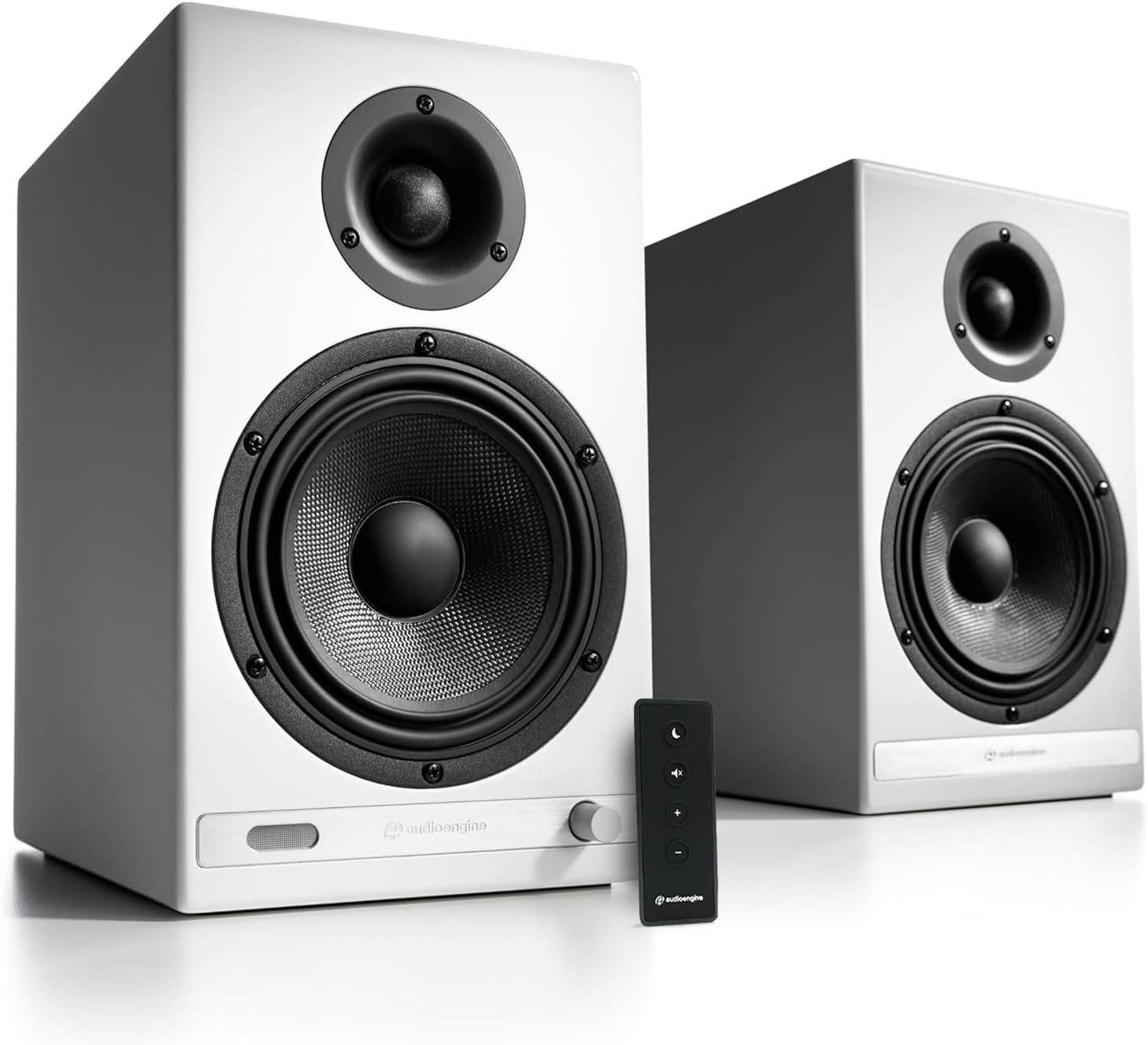
The Audioengine HD6 is a hand-built nearfield reference point. Its 1-inch silk dome tweeter delivers a laid-back, non-fatiguing top end that avoids the harshness of metal-dome alternatives, while the 5.5-inch Kevlar woofer provides taut, controlled bass down to 50Hz. The 150W total amplifier (50W RMS per channel) has generous headroom for dynamic swings.
The built-in 24-bit DAC (up to 192kHz) processes optical and USB signals, bypassing your computer or TV’s noisy sound card. Bluetooth 5.0 with aptX HD mean wireless streaming approaches CD quality, and the aluminum remote feels premium in hand. The real wood veneer cabinets with magnetic grilles are designed to sit beautifully on a desk or credenza.
A subwoofer output is included for those who want deeper extension, and the 30-day risk-free trial with a 3-year warranty provides peace of mind. For desktop listeners who prioritize clarity over sheer volume, the HD6 rewards with detail retrieval that reveals new layers in familiar recordings.
Why it’s great
- Silk dome tweeter offers fatigue-free listening for hours
- High-quality 24-bit DAC with optical and USB input
- 3-year warranty and 30-day risk-free trial
Good to know
- Requires 40-50 hour break-in period for optimal sound
- Large footprint may overwhelm smaller desks
4. KRK RP8G5 Rokit 8

The KRK Rokit 8 G5 is the professional studio standard for a reason. The 8-inch woven Kevlar aramid fiber woofer produces tight, accurate low-end that reveals mix details ordinary speakers mask. The 1-inch soft dome tweeter handles the top end with minimal sibilance, while the Class A/B amplifier delivers 112dB max SPL — enough to fill a treated room without strain.
The fifth-generation design introduces 25 boundary and tuning EQ combinations via rear DIP switches, letting you compensate for room placement issues like corner bass buildup or desk reflections. The Low Diffraction Baffle reduces edge reflections for better stereo imaging, and the included isolation foam pads decouple the monitors from the surface.
Inputs are XLR and 1/4-inch TRS combo jacks — professional connectivity that assumes an external audio interface. This makes the Rokit 8 best suited for producers, engineers, and serious critical listeners who own a DAC or audio interface already.
Why it’s great
- 25 EQ tuning settings for room acoustics correction
- 8″ Kevlar woofer delivers authoritative, accurate bass
- Includes acoustic foam isolation pads
Good to know
- No Bluetooth or consumer inputs like HDMI/RCA
- Previous generation had power supply failure reports
5. Fluance Ai61

The Fluance Ai61 delivers a 120W integrated amplifier and 6.5-inch woven glass fiber drivers that punch well above their price point. The internally braced MDF cabinets kill resonance dead, and the rear bass port extends low-end response without boominess. Reviewers consistently note zero hiss from the amplifier — a sign of clean power supply design.
Connectivity is comprehensive for the mid-range: RCA, optical, and USB-C inputs plus Bluetooth 5 for wireless streaming. The subwoofer output lets you add a dedicated sub later, and the included IR remote controls volume, input, and source switching. The natural walnut finish looks substantially more expensive than the asking price.
Sound signature is balanced with a slight warmth in the mids — excellent for rock, jazz, and vocals. The sweet spot is a medium room (12×15 feet or so) where the 6.5-inch drivers can breathe. For desktop use, the 6.5-inch woofers may be overpowering; these are better on a console or speaker stands.
Why it’s great
- 120W amp delivers authoritative, room-filling power
- Hot-swappable inputs: RCA, Optical, USB-C, Bluetooth
- Zero amplifier hiss confirms clean power rail design
Good to know
- Lacks detachable front grille for bare driver protection
- Large size may dominate a desk setup
6. Audio-Technica AT-SP3X

Audio-Technica designed the AT-SP3X to match its turntable lineup, and it shows in the tuning. The 3-inch full-range driver is specially voiced for vinyl reproduction — warm, smooth, and easy-going without the analytical edge of studio monitors. Bluetooth multipoint keeps your phone and turntable connected simultaneously, switching inputs seamlessly.
The compact plastic enclosure is lightweight and fits on narrow shelves or desks where larger speakers won’t. The front volume knob with integrated power LED is simple and clean, and the included international AC adapters make this travel-ready for global use. Sound is surprisingly loud for the size, though the 3-inch driver cannot produce deep bass below 80Hz.
For a small bedroom, office, or secondary system, the AT-SP3X delivers a coherent listening experience. RCA and Bluetooth inputs cover the essentials, and the candy packaging is a delightful touch. This is not a speaker for critical listening or large rooms — it is a lifestyle companion that sounds bigger than it looks.
Why it’s great
- Bluetooth multipoint keeps phone and turntable connected
- Specially voiced for vinyl warmth and smoothness
- Compact footprint fits narrow shelving
Good to know
- 3″ driver lacks deep bass extension below 80Hz
- Plastic cabinet may resonate at higher volumes
7. Sony SS-CS5M2

The Sony SS-CS5M2 is a passive 3-way bookshelf speaker that requires an external amplifier or AV receiver — included here because its sound quality and price position it as a serious contender when paired with a budget stereo amp. The 5.12-inch woofer, high-precision tweeter, and wide-dispersion super tweeter create a genuinely expansive soundstage for the driver size.
Frequency response extends from 53Hz to 50kHz, covering the full audible spectrum plus ultrasonic headroom for hi-res audio. The bass reflex enclosure with a rear port needs a few inches of clearance from the wall. The reinforced cellular cone woofer keeps distortion low even at moderate volumes.
Stereo imaging is the star here — the super tweeter creates a wide, airy soundstage that makes instruments feel precisely placed. Bass is punchy for a 5-inch driver but lacks sub-50Hz weight. Pairing with a powered subwoofer transforms these into a formidable nearfield system. At the right sale price, these are a steal for listeners who already own an amplifier.
Why it’s great
- 3-way design with dedicated super tweeter for wide soundstage
- 53Hz-50kHz response handles hi-res audio formats
- Compact 5.12″ woofer punches above its weight
Good to know
- Passive design requires external amplifier — not powered
- Bass limited below 53Hz; subwoofer recommended
- Best value at sale price, not full MSRP
8. Edifier R1280T

The Edifier R1280T is the budget champion that defined the powered bookshelf category. The 13mm silk dome tweeter and 4-inch full-range driver produce a natural, non-fatiguing sound that outclasses computer speakers at twice the price. The 42W RMS amplifier (21W per channel) provides sufficient volume for a small room or desk setup.
The classic wood-effect MDF cabinets look more expensive than they are, and the side-panel bass and treble knobs let you dial in the tone without an app. The included remote controls volume and inputs, and the dual AUX inputs let you switch between a computer and phone without unplugging cables.
Bass is present but not powerful — a subwoofer out is not included, so deep bass lovers will want to add a separate sub via a splitter. For entry-level listeners, vinyl enthusiasts on a budget, or anyone creating a simple desktop system, the R1280T remains the gold standard for value.
Why it’s great
- Silk dome tweeter delivers smooth, non-fatiguing highs
- Dual AUX inputs for seamless source switching
- Side-panel bass and treble EQ with included remote
Good to know
- No Bluetooth — wired AUX only
- Bass is modest; subwoofer upgrade path requires external splitter
9. Edifier MR3

The Edifier MR3 brings professional studio features to the budget tier. Hi-Res Audio certification guarantees a flat frequency response from 52Hz to 40kHz, while the balanced TRS inputs allow direct connection to audio interfaces and studio gear — rare at this price. The 18W RMS per channel amplifier drives the 3.5-inch mid-low driver and 1-inch tweeter to a 92.5dB peak SPL.
Three listening modes — Music, Monitor, and Custom — let you toggle between a flatter monitoring curve and a more consumer-friendly sound signature. The EDIFIER ConneX app provides in-depth EQ adjustments, and Bluetooth 5.4 supports multi-point connections for seamless switching between a phone and computer. The MDF cabinet reduces distortion compared to plastic competitors.
Reviewers consistently praise the clarity and detail retrieval, especially at low volumes. The rose gold and black finish options add visual flair. For budget-conscious content creators or desktop listeners who want a neutral, revealing sound with professional connectivity, the MR3 punches far above its weight class.
Why it’s great
- Balanced TRS inputs for direct audio interface connection
- Hi-Res Audio certified with flat 52Hz-40kHz response
- App-based EQ and three listening mode presets
Good to know
- 3.5″ driver limits maximum SPL in larger rooms
- Bluetooth volume not synchronized with device volume
FAQ
Do I need a subwoofer with amplified stereo speakers?
What is the difference between active and passive speakers?
What Bluetooth codec should I look for?
Final Thoughts: The Verdict
For most users, the best amplified stereo speakers winner is the Klipsch The Sevens because it combines a massive 6.5-inch high-excursion driver with HDMI-ARC simplicity and built-in phono preamp — a genuine all-in-one solution for music and TV. If you want deep studio-grade bass and critical monitoring accuracy, grab the KRK Rokit 8 G5. And for a budget-friendly nearfield setup with professional balanced inputs, nothing beats the Edifier MR3.