
Our readers keep the lights on and my morning glass full of iced black tea. As an Amazon Associate, I earn from qualifying purchases.
Picking an AV surround receiver is the single most impactful decision for your home theater — it is the brain that decides how your speakers, TV, and gaming consoles talk to each other. The wrong pick leaves you with weak sound, confusing menus, or HDMI ports that do not actually work with your devices. This guide walks you through eight receivers that cover the real ground between budget-friendly and premium, so you know exactly which one fits your room, your speakers, and your patience for setup.
I’m Min — the founder and writer behind Gadgets Feed. This guide is built by comparing the manufacturers’ published specifications and the patterns across verified customer reviews, so you get each pick’s real strengths and trade-offs instead of marketing spin.
Whether you are building a new system from scratch or upgrading an older receiver, understanding the channel count and room correction features is half the battle. Read on for the breakdown of the best av surround receiver options that actually deliver on their big promises.
Quick Picks
- YAMAHA RX-V6A 7.2-Channel AV Receiver with MusicCast — Best Overall
- Denon AVR-S970H 8K Ultra HD 7.2 Channel Receiver — Best Value
- Onkyo TX-NR7100 9.2-Channel AV Receiver — Serious Room Correction
- Sony STR-AN1000 7.2 CH Surround Sound Home Theater 8K A/V Receiver — Immersive Audio
- Yamaha RX-A4A AVENTAGE 7.2-Channel AV Receiver — Premium Pick
- Sony STRAZ1000ES Premium ES 7.2 CH 8K A/V Receiver — Custom Integrator Pick
- JBL MA9100HP 9.2-Channel 8K AV Receiver — Compact Powerhouse
- Pioneer VSX-935 7.2 Channel Surround Sound Network Receiver — Budget Champion
How To Choose The Best AV Surround Receiver
An AV receiver does three jobs — it decodes audio formats (like Dolby Atmos), switches your video sources (game console, streaming stick, Blu-ray player), and sends amplified power to your speakers. The right one depends on your room size, how many speakers you want, and whether you need bleeding-edge HDMI features for a new TV.
Channel Count: 5.1, 7.2, or 9.2?
The first number is the main speakers, and the second is the number of subwoofers. A 5.1 system gives you left, center, right, two surrounds, and one sub. A 7.2 adds two rear surround speakers and a second subwoofer output. A 9.2 adds two height (ceiling) channels for true overhead Dolby Atmos effects. More channels mean more speakers to buy and more wires to run, so match the count to your room layout.
Room Correction: Why Your Room Sounds Bad
Every room has quirks — reflections off walls, booming bass in corners, muffled dialogue. Room correction software (Dirac Live, YPAO, Audyssey) uses a microphone to measure these problems and automatically tweaks the receiver’s output to fix them. This is one of the most important features for getting clear, balanced sound without guesswork.
HDMI 2.1: For Gamers and 8K TVs
HDMI 2.1 ports support 4K resolution at 120Hz (very smooth gaming) and 8K at 60Hz. They also allow features like Variable Refresh Rate (VRR) and Auto Low Latency Mode (ALLM) for lag-free gaming. If you have a PlayStation 5, Xbox Series X, or an 8K TV, you need a receiver with HDMI 2.1 inputs — otherwise, the receiver becomes the bottleneck.
Quick Comparison
On smaller screens, swipe sideways to see the full table.
| Model | Best For | Channels | HDMI 2.1 | Room Correction | Amazon |
|---|---|---|---|---|---|
| YAMAHA RX-V6A | Reliable all-around pick | 7.2 | Yes (3 inputs) | YPAO R.S.C. | $645.99$679.95Amazon |
| Denon AVR-S970H | Turntable-friendly hub | 7.2 | Yes (3 inputs) | Audyssey | $849.00$949.00Amazon |
| Onkyo TX-NR7100 | Serious room correction | 9.2 | Yes | Dirac Live | $749.00$1,299.00Amazon |
| Sony STR-AN1000 | Virtual overhead sound | 7.2 | Yes | D.C.A.C. IX | $1,048.00$1,149.99Amazon |
| Yamaha RX-A4A | Premium build + surround:AI | 7.2 | Yes (7 inputs) | YPAO R.S.C. 3D | $1,199.00Amazon |
| Sony STRAZ1000ES | Custom integration | 7.2 | Yes | D.C.A.C. IX | $1,498.00Amazon |
| JBL MA9100HP | Compact, powerful 9.2 | 9.2 | Yes | — | Amazon |
| Pioneer VSX-935 | Budget entry to Atmos | 7.2 | Yes | MCACC | $539.00Amazon |
In‑Depth Reviews
1. YAMAHA RX-V6A 7.2-Channel AV Receiver with MusicCast

The jack-of-all-trades Yamaha that hits the balance of features, power, and sanity.
This 7.2-channel receiver gives you a 200W total output (all channels driven) and three HDMI 2.1 inputs that support 8K at 60Hz and 4K at 120Hz — exactly what you need if you own a PlayStation 5 or Xbox Series X. It decodes Dolby Atmos and DTS:X, and the YPAO R.S.C. (Yamaha Parametric Acoustic Optimizer with Reflected Sound Control) room correction automatically fixes your room’s sonic quirks using the supplied microphone. You also get Wi-Fi, Bluetooth, AirPlay 2, and MusicCast multi-room, so streaming from Spotify or TIDAL is smooth.
Buyers report it “replaces Onkyo TX-NR6050” and call the audio superior, with clear dialogue and dynamic action. The catch? The on-screen menu overlay looks dated, and eARC can be finicky — one owner noted it “does not auto-power on with Sony Bravia TV” and the setup can be complex. It also measures just 6.25 inches deep, making it 2.4 times shallower than the Onkyo TX-NR7100 (which is 14.9 inches deep), so it fits easily in shallow media consoles.
Why it’s great
- Three HDMI 2.1 inputs for 8K/60Hz and 4K/120Hz gaming
- YPAO R.S.C. room correction with multipoint measurement
- Compact depth (6.25 inches) fits most furniture
Good to know
- Dated on-screen menu interface
- Requires latest firmware for full stability
Best for: Buyers who want a balanced feature set — HDMI 2.1 gaming, room correction, and streaming — without overpaying.
Skip if: You need a 9-channel setup for discrete ceiling speakers (this is a 7.2 receiver).
2. Denon AVR-S970H 8K Ultra HD 7.2 Channel Receiver

A Denon that brings 90 watts per channel and a built-in phono input for vinyl fans.
This 7.2-channel receiver delivers 90W per channel (into 8 ohms at 1 kHz, THD 0.9%) and includes a phono input so you can plug in a turntable directly — no external preamp needed. It supports Dolby Atmos, DTS:X, and HDMI 2.1 with VRR, QFT, and ALLM for gaming. Owners mention that it “runs cooler (80°F vs 90-92°F)” than older receivers and the Audyssey room correction does a solid job for medium-sized rooms. The HEOS app lets you stream from Spotify, TIDAL, and Pandora to other rooms.
One owner who upgraded from a Sony specifically praised the “powerful sound” and “versatile HDMI and eARC.” The downside is that using the powered Zone 2 feature consumes the rear surround speaker connections, limiting your main setup to 5.1. Another reviewer noted the remote “lacks programmable TV power button,” so you may still need your TV remote for power control.
The case for it: You get genuine 90W per channel, a phono input, and Audyssey room correction at a mid-range price — rare value for vinyl-loving home theater fans.
The trade-off: Powered Zone 2 steals the rear speaker channels, so you cannot have both 7.1 in the main room and a second zone running simultaneously.
Best for: Home theater owners who also play vinyl records and want a single box that handles both.
Skip if: You plan to run a 7.1 setup and a separate second zone at the same time (you would lose the rear surrounds).
3. Onkyo TX-NR7100 9.2-Channel AV Receiver
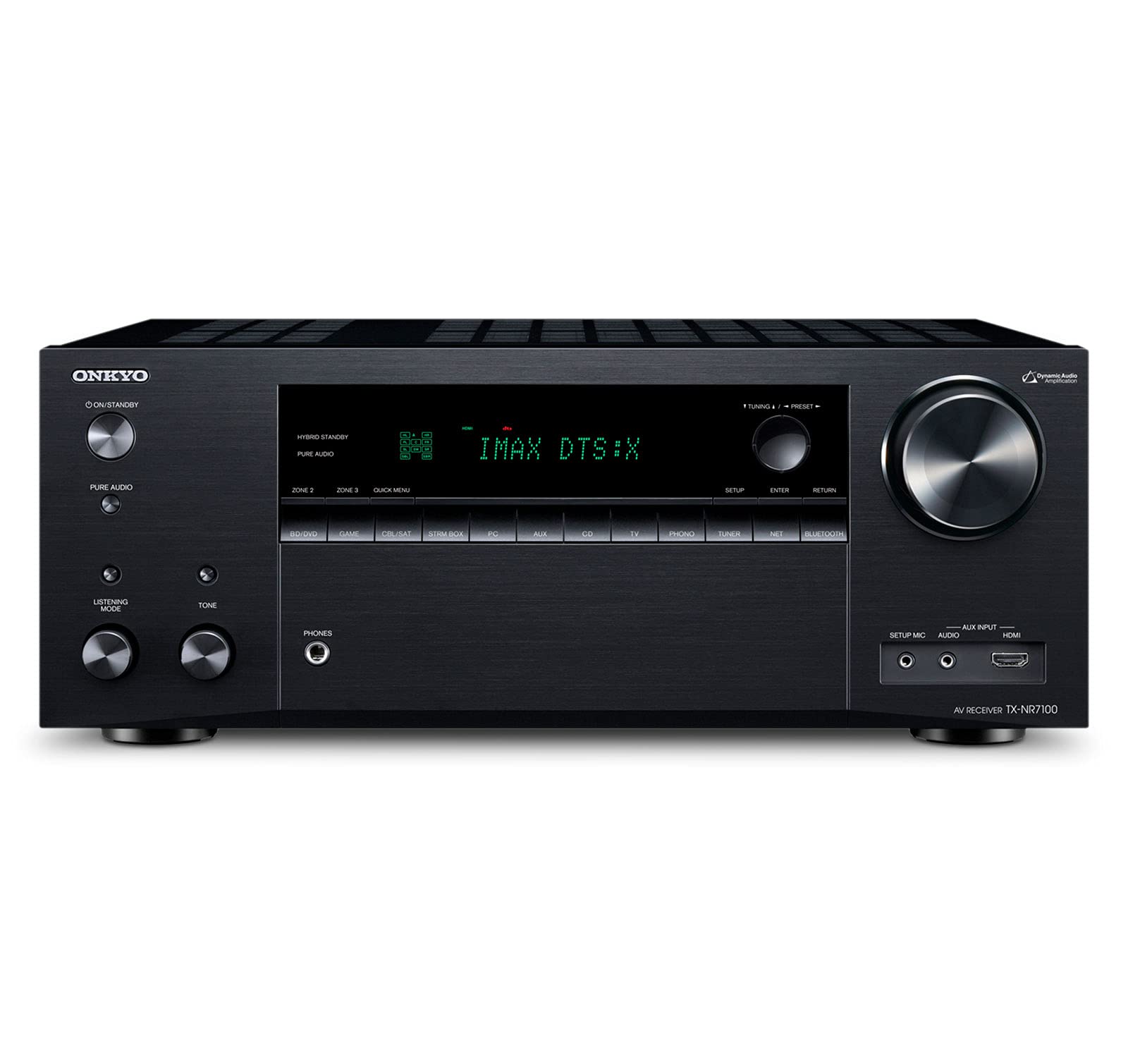
A 9.2-channel beast with Dirac Live room correction that transforms tricky rooms.
This receiver packs 9 channels of amplification (100W per channel) and 2 subwoofer outputs, giving you a 9.2 or 7.2.2 setup (7 main speakers plus 2 height channels). The standout feature is Dirac Live room correction — you measure your room with the included wired microphone, and the software automatically calibrates speaker distances, levels, and EQ to eliminate muddy bass and harsh treble. One reviewer called the Dirac Live effect “transformative” for sound quality. It also has THX certification, meaning it meets strict performance standards for home theater.
Customers note that the “basic set-up is relatively easy” and the sound is excellent for both movies and music. However, one owner reported a “faulty unit developed crackling/static noise after 1-2 months” — a risk with any electronic component. The remote also has a short range, and the receiver runs warm, so ensure good ventilation.
Why it’s great
- Dirac Live room correction — one of the best in this price tier
- 9.2 channels for a full 7.2.2 Atmos setup with ceiling speakers
- THX Certified for reliable home theater performance
Good to know
- Some units have had reliability issues (crackling/static reported)
- Remote has limited range; menus look a bit basic
Best for: Home theater enthusiasts who want advanced room correction and the flexibility to add two height speakers.
Skip if: You want a rock-solid unit with a backlit remote and simpler menus — consider the Yamaha RX-V6A instead.
4. Sony STR-AN1000 7.2 CH Surround Sound Home Theater 8K A/V Receiver

Sony’s 360 Spatial Sound Mapping creates convincing overhead effects without ceiling speakers.
This 7.2-channel receiver delivers 165W into 6 ohms (1 kHz, 1ch, THD 0.9%) and uses Sony’s Digital Cinema Auto Calibration IX (D.C.A.C. IX) plus 360 Spatial Sound Mapping to create a virtual surround and height bubble. Reviewers point out the “360 spatial mapping and virtual speaker placement create convincing sound from absent speakers” — meaning you can get a Dolby Atmos-like effect without installing actual ceiling speakers. It has 6 HDMI inputs (2 outputs) with HDMI 2.1 support for 8K and 4K/120 passthrough.
One owner who upgraded from a Sony STR-DN840 said the sound was “markedly better” and that his wife noticed the immersion improvement while watching Ponyo. On one limitation, the auto-calibration mis-measured their subwoofer distance by 12 feet, and a known issue prevents Dolby Vision passthrough to the Apple TV 4K. It also lacks a phono input for turntables, so vinyl fans will need an external preamp.
The case for it: The 360 Spatial Sound Mapping is genuinely impressive for creating height effects from a 7.2 speaker layout — you hear sounds above you without buying ceiling speakers.
The compromise: No phono input for turntables, and the auto-calibration can mis-measure speaker distances, requiring manual tweaks.
Best for: Anyone who wants immersive Dolby Atmos effects but cannot install ceiling speakers — the virtual height trick works well.
Skip if: You own a turntable (no built-in phono stage) or need flawless Dolby Vision passthrough for Apple TV 4K.
5. Yamaha RX-A4A AVENTAGE 7.2-Channel AV Receiver

Yamaha’s AVENTAGE line delivers high-end build and an AI that adjusts audio on the fly.
This 7.2-channel receiver from Yamaha’s top-tier AVENTAGE line includes Surround:AI technology — a system that analyzes audio content in real time and automatically adjusts the sound field to emphasize dialogue, action, or music depending on the scene. It has 7 HDMI inputs (3 outputs), all supporting 8K at 60Hz and 4K at 120Hz at 40 Gbps, plus ALLM and VRR for gaming.
Shoppers say the sound is so accurate that “the room seems so much bigger.” The YPAO R.S.C. with 3D and multipoint measurement provides advanced room calibration. One owner noted that the firmware update “needs USB drive” and the setup is “brutal” and confusing. Another said the “Surround: AI pushes too much voice to center on old stereo content,” so you may need to switch modes for music. It also includes a phono input for turntables — unlike the Sony STR-AN1000.
Why it’s great
- Surround:AI automatically optimizes audio for each scene
- 7 HDMI 2.1 inputs all support 8K60 and 4K120 at 40 Gbps
- Phono input for vinyl, and high-quality DAC for music
Good to know
- Setup is complex and firmware update requires a USB flash drive
- Surround:AI can over-boost center channel on older stereo content
Best for: Enthusiasts who want premium build quality, the most HDMI 2.1 inputs on the list, and AI-assisted sound tuning.
Skip if: You want a simple plug-and-play setup — the calibration and firmware process is not beginner-friendly.
6. Sony STRAZ1000ES Premium ES 7.2 CH 8K A/V Receiver

Sony’s ES series is built for custom installers who need IP control and rock-solid reliability.
This 7.2-channel receiver delivers 100W + 100W into 8 ohms (1 kHz, 2ch, THD 0.9%) and is designed for custom in-home integration with smooth IP Control, meaning it works with professional control systems like Crestron or Control4. It uses the same Digital Cinema Auto Calibration IX and 360 Spatial Sound Mapping as the STR-AN1000 but in a more robust chassis. One reviewer called the 360 Spatial Sound Mapping “magical” and said their 5.1.2 setup sounded like 7.1.4.
Buyers report the sound quality is “the most amazingly sounding receiver you will ever hear.” However, it runs very hot — one owner recommends pairing it with an AC Infinity Aircom T10 cooling fan. It also lacks HDR10+ and QMS (Quick Media Switching) support, so if your TV uses HDR10+, you will miss out on dynamic metadata. The ES series is optimized for professional installers who need IP control and front-panel setup options.
The case for it: top-tier for custom home integration — IP control, backlit remote, and 360 Spatial Sound Mapping that turns a 5.1.2 system into a convincing 7.1.4 experience.
The drawback: Runs very hot (needs active cooling), and lacks HDR10+ support, limiting dynamic HDR on some new TVs.
Best for: Custom home theater installations with professional control systems (Crestron, Control4).
Skip if: Your TV supports HDR10+ (you will miss that format), or you want a receiver that stays cool without extra fans.
7. JBL MA9100HP 9.2-Channel 8K AV Receiver

A 9.2-channel JBL that fits in shallow cabinets and runs cool with Class D amps.
This receiver delivers 9.2 channels using low-noise Class D amplification — which runs cooler and more efficiently than traditional Class A/B amplifiers. It supports Dolby Atmos and DTS:X, and you can configure it as 9.1, 7.1.2, or 5.1.4 (5 main, 1 sub, 4 height). It has 6 HDMI inputs and 2 outputs with eARC. At 7.6 kilograms and 5.3 inches tall, it is one of the most compact 9-channel receivers on the market.
Owners mention that the “shallow design fits media console” easily, and the sound quality is impressive when paired with in-wall speakers. However, one owner noted the “remote not backlit, impossible to navigate in the dark” — a real annoyance in a dark theater room. Another reported that it “does not mix down multi-channel DTS-HD Master Audio to 2.1,” which is a problem if you only run a 2.1 setup. The auto shut-off defaults to 20 minutes and must be changed manually.
Why it’s great
- 9.2 channels with Class D amplification for cool operation
- Compact size (5.3 inches tall, 15.6 inches deep) fits most cabinets
- Supports 5.1.4 Atmos configuration with four height speakers
Good to know
- Remote is not backlit — a real issue in dark rooms
- No down-mixing of DTS-HD Master Audio to 2.1 for simple setups
Best for: Buyers who need 9 channels plus a shallow chassis that slides into tight AV cabinets without overheating.
Skip if: You run a 2.1 system (no DTS-HD down-mix) or need a backlit remote for dark room use.
8. Pioneer VSX-935 7.2 Channel Surround Sound Network Receiver

The cheapest way into Dolby Atmos with Height Virtualization and HDMI 2.1.
This 7.2-channel receiver is the budget entry point for Dolby Atmos — it supports Dolby Atmos Height Virtualization, which creates a virtual surround and height effect from traditional speaker layouts without needing additional surround or height speakers. It has HDMI 2.1 with 8K passthrough and supports Enhanced Gaming (VRR, ALLM). Reviewers report the sound is “crisp, clear, loud” and the RF remote (radio frequency remote) works through walls.
At 7.2 channels, it has 28% fewer channels than the Onkyo TX-NR7100 (9.2), so you cannot add discrete ceiling speakers. Customers note that the “first unit DOA; vendor replaced quickly” — a frustrating but common issue with budget electronics. Another owner struggled with HDMI video failure from a computer (snow, black screen, constant refresh). The firmware update is USB-only and can fail with error codes. Despite reliability concerns, it remains the most affordable receiver on this list that supports the latest HDMI standards.
The case for it: You get Dolby Atmos Height Virtualization, HDMI 2.1, and 7.2 channels at the lowest entry price — perfect for dipping your toe into immersive audio without spending big.
The catch: Reliability is a gamble — multiple reviews mention DOA units, HDMI handshake issues, and frustrating USB-only firmware updates.
Best for: Budget-conscious buyers who want HDMI 2.1 and virtual Dolby Atmos without buying ceiling speakers.
Skip if: You need rock-solid reliability — Pioneer’s QC record here is inconsistent, and you may spend hours troubleshooting.
Understanding the Specs
Wattage Per Channel
This is the power each speaker channel can deliver. More watts means louder, cleaner sound without distortion, especially at high volumes. The top pick Yamaha RX-V6A offers 200W total, while the Denon AVR-S970H provides 90W per channel. If you have hard-to-drive speakers (some floor-standing models), look for higher wattage.
Room Correction (Dirac vs YPAO vs Audyssey)
Room correction is a microphone-based system that measures how your room affects sound — reflections off walls, bass buildup in corners — and applies automatic EQ to fix those issues. Dirac Live (Onkyo TX-NR7100) is considered the gold standard, while YPAO (Yamaha RX-V6A) and Audyssey (Denon AVR-S970H) are very good but less granular. Sony’s D.C.A.C. IX also includes 360 Spatial Sound Mapping for virtual height effects.
FAQ
What is the difference between 7.2 and 9.2 channels?
Do I need HDMI 2.1 for my AV receiver?
Can I use Dolby Atmos without ceiling speakers?
Will my old speakers work with a new AV receiver?
What is eARC and why does it matter?
How long do AV receivers last?
Is the Sony STR-AN1000 better than the Denon AVR-S970H?
Does the JBL MA9100HP support Dolby Atmos?
What is the best AV receiver for gaming?
Should I buy a more expensive receiver for better sound quality?
Final Thoughts: The Verdict
If you want one dependable pick, the best av surround receiver winner is the Yamaha RX-V6A because it delivers HDMI 2.1 gaming support, YPAO room correction, and reliable sound quality in a compact chassis at a mid-range price. If you want a built-in phono input for your turntable and Audyssey room correction, grab the Denon AVR-S970H. And for the ultimate in room correction with Dirac Live and 9.2 channels for ceiling Atmos speakers, the standout is the Onkyo TX-NR7100.
How We Picked
We do not accept paid placement, and we did not hands-on test every unit. Instead, we match each pick to a real buyer and use-case by comparing the manufacturers’ published specifications against the patterns in verified customer reviews — so you get each pick’s real strengths and trade-offs instead of marketing copy.
Sources & Methodology
Specifications: manufacturer listings and product documentation. Review insights: verified customer reviews, as of July 2026. Pricing: not shown on this page (it changes often); check the current price via the retailer link.
As an Amazon Associate, Gadgets Feed earns from qualifying purchases. This does not affect which products we feature.
Product prices and availability are accurate as of the date/time indicated and are subject to change. Any price and availability information displayed on Amazon at the time of purchase will apply to the purchase of this product. As an Amazon Associate I earn from qualifying purchases.
CERTAIN CONTENT THAT APPEARS ON THIS SITE COMES FROM AMAZON. THIS CONTENT IS PROVIDED "AS IS" AND IS SUBJECT TO CHANGE OR REMOVAL AT ANY TIME.
Amazon and the Amazon logo are trademarks of Amazon.com, Inc. or its affiliates.