
The metal armor on 12/3 MC cable does the job of pipe and wire in a single pull — saving hours of bending conduit and threading wire on every job. Whether you’re wiring a garage workshop, running a 20-amp circuit to an EV charger, or roughing in a basement, that interlocking aluminum jacket is the difference between a full-day conduit project and a two-hour cable run.
I’m Min — the co-founder and writer behind Gadgets Feed. I’ve spent countless hours cross-referencing UL listings, NEC code allowances, and customer field reports to isolate which 12/3 MC cable delivers real mechanical protection without fighting you during installation.
From 25-foot starter spools to 250-foot warehouse coils, this guide breaks down the real-world differences in conductor material, armor flexibility, and ampacity. Use this analysis to find the right 12/3 mc cable for your specific project without overbuying or underspecifying.
How To Choose The Best 12/3 MC Cable
Not all 12/3 MC cable is the same under the armor. The conductor metal, jacket alloy, and spool length directly affect how the cable handles during installation and how it performs under load over distance.
Conductor Material: Copper vs. Aluminum
Copper conductors carry 20 amps with lower resistance per foot than aluminum, meaning less voltage drop on runs beyond 50 feet. Aluminum conductors are lighter and cheaper but require larger gauge equivalents to match copper’s ampacity. For a 20-amp circuit using 12 AWG, copper is the standard.
Length Planning and Voltage Drop
A 100-foot 12/3 copper MC cable run at 16 amps loses roughly 3.2% voltage — acceptable for most branch circuits. Aluminum conductors of the same gauge will lose over 5%, pushing the limit for sensitive equipment. Buy the shortest length that comfortably reaches your farthest box to keep copper costs in check.
Armor Type and Stripping Method
Aluminum interlocking armor is flexible and 45% lighter than steel, but it kinks if bent sharply. A standard rotary cutter or hacksaw with a fine blade works cleanly; side cutters risk pinching the inner wires. Look for armor that reverses easily at the end without fraying.
Quick Comparison
On smaller screens, swipe sideways to see the full table.
| Model | Category | Best For | Key Spec | Amazon |
|---|---|---|---|---|
| Southwire 68583422 | Copper, 50 ft | Mid-run branch circuits | 12 AWG, 3 Copper Conductors | Amazon |
| Southwire Armorlite 100 ft | Premium Copper 100 ft | Whole-room rewiring | THHN/THWN, 600V, 100 ft | Amazon |
| Southwire 68583421 | Aluminum, 25 ft | Small quick runs | 12 AWG, 3 Aluminum Conductors | Amazon |
| Kimbluth 12/3 MC 50 ft | Copper, 50 ft | EV charger installs | Solid Bare Copper, 2.05mm | Amazon |
| VN Infinite 12/3 UF-B | Copper, 50 ft | Underground burial | Direct Burial PVC Jacket | Amazon |
| Southwire 68580023 | Aluminum, 100 ft | Long single-circuit runs | 12/2, Aluminum Armor | Amazon |
| Southwire 68583401 | Copper, 250 ft | Large-scale projects | Soft Drawn Copper, 250 ft | Amazon |
In‑Depth Reviews
1. Southwire 12/3 Solid Copper Armorlite MC Cable, 100 ft

This Southwire Armorlite spool uses solid 12 AWG copper THHN/THWN conductors rated for 90°C dry conditions, wrapped in an aluminum interlocking armor that runs cleanly through stud bays and cable trays. The 100-foot length is the sweet spot for whole-room rewiring — enough for a full basement circuit or a long garage run without wasteful leftovers.
The four-conductor bundle includes black, red, white, and green insulated wires, giving you both hot legs and a dedicated ground for 240-volt appliances or multi-wire branch circuits. Buyers consistently note the price per foot undercuts big-box retailers, and the aluminum armor makes pulling through multiple joist holes noticeably easier than steel-armored alternatives.
Field feedback highlights one downside: the armor kinks if you bend it sharply during routing. Use a gradual radius around corners, and avoid crushing the jacket with a hammer staple. Overall, this is the most code-compliant, versatile 12/3 MC cable for the serious DIYer or professional.
Why it’s great
- Solid copper THHN/THWN conductors minimize voltage drop on 100-ft runs
- Lightweight aluminum armor weighs 45% less than steel MC
- Approved for environmental air-handling spaces per NEC 300.22(C)
Good to know
- Armor kinks if bent sharply — use a gentle radius
- Not marked for direct outdoor burial
2. Southwire 68583422 50′ 12/3 Type MC Cable Aluminum
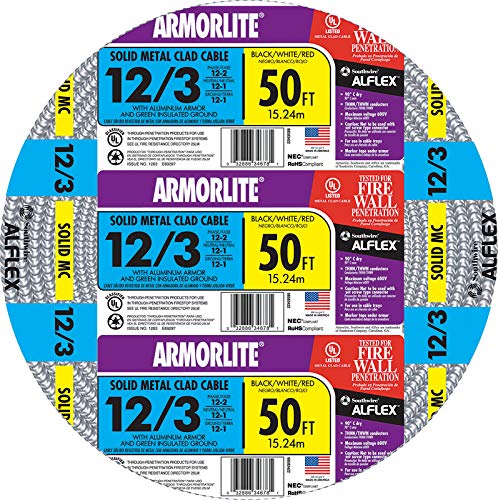
The 50-foot Southwire 68583422 gives you copper conductors inside an aluminum armor jacket at a per-foot cost that regularly beats local hardware store pricing. It carries a 20-amp, 600-volt rating with multi-strand copper for flexibility during installation — critical when feeding through pre-existing wall cavities with tight bends.
Contractors and serious DIYers praise this spool for mid-range projects such as running a circuit from the panel to a workshop sub-panel or feeding a basement finishing job. The 50-foot length avoids the premium price jump of 100-foot rolls while still giving enough slack for most single-room or single-appliance circuits.
The main caveat: the aluminum armor can deform under heavy stomping or if you run a staple gun too aggressively. Use cable staples that match the 0.590-inch overall diameter, and do not overtighten. If you need a straightforward, budget-friendly copper conductor MC cable for a 20-amp branch, this is your pick.
Why it’s great
- Multi-strand copper conductors are easier to bend in tight spaces
- Excellent price per foot compared to big-box stores
- UL-listed for branch, feeder, and service power distribution
Good to know
- Aluminum armor dents more easily than steel
- Not suitable for direct burial without conduit
3. Kimbluth 12/3 Metal Clad Cable with Ground 50ft
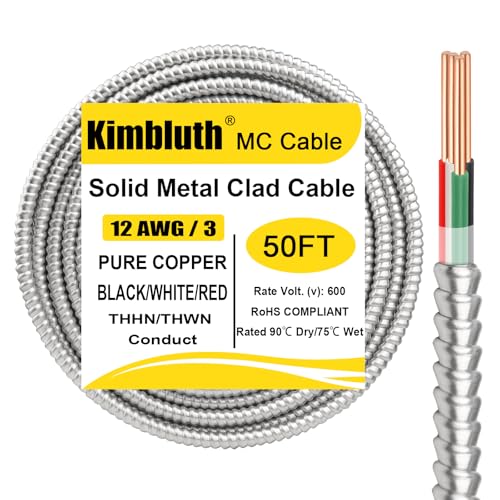
The Kimbluth 12/3 MC cable uses solid bare copper conductors with a 2.05mm diameter — slightly above the nominal 12 AWG standard — which translates to better conductivity and heat dissipation under continuous loads. That matters when you’re pulling 16 amps for hours through an EV charger or a high-draw workshop tool.
It ships with four conductors: three current-carrying insulated wires plus a separate bare ground, giving you the full 3-wire-plus-ground setup required for 240-volt circuits. The aluminum alloy jacket meets UL 1569 and UL 2556 standards, and one verified installer used it successfully for a Level 2 EV charger installation with no issues over months of daily charging.
The armor cuts cleanly with a hacksaw or rotary tool, but the 12.6mm overall diameter means it requires a larger knockout hole in junction boxes than standard 12/2 cable. Confirm your box connectors fit this thicker cable before you start pulling.
Why it’s great
- 2.05mm solid copper conductors exceed minimum 12 AWG diameter
- Four-conductor bundle enables 240V multi-wire branch circuits
- UL 1569 and UL 2556 certified for industrial and commercial use
Good to know
- Thicker overall jacket requires larger box knockouts
- Stripping armor without scratching wire insulation takes care
4. Woods Southwire 68583421 25-Foot 12/3 MC Cable
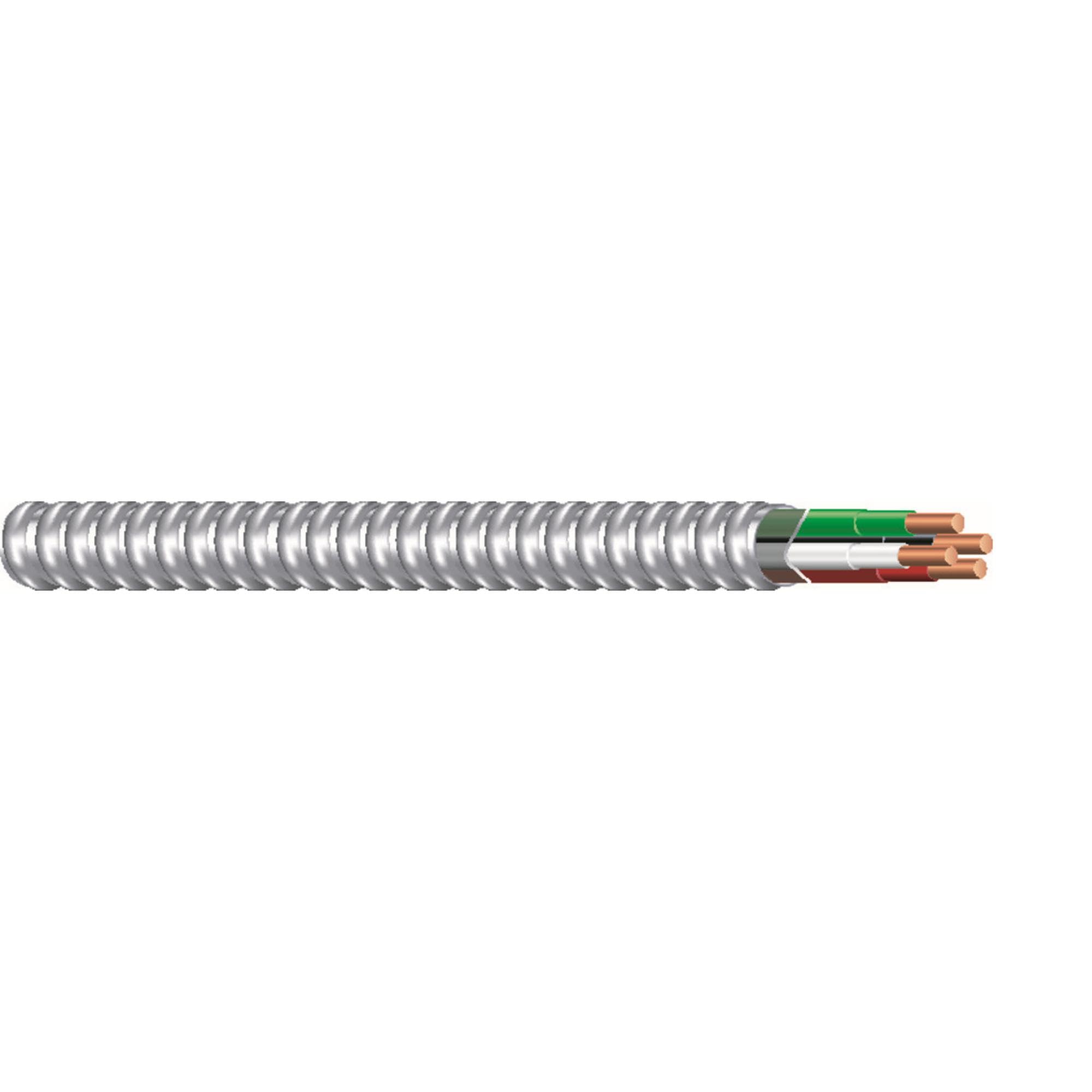
This 25-foot Southwire spool uses aluminum conductors inside aluminum armor, making it the lightest 12/3 option on the list at just 3.1 pounds total. The low weight and short length make it ideal for small indoor projects like connecting a water heater, running a short branch to a garage outlet, or wiring a single junction box.
The aluminum conductors are rated for 20-amp branch circuits, but be aware that voltage drop on aluminum wire is higher than copper over the same distance. At 25 feet, the difference is negligible — under 1% — so this cable works fine for short runs where weight and price are the primary concerns.
Buyers report easy stripping with standard side cutters and a hacksaw, though a couple note the armor can splinter if you cut at an angle. The NEC no longer requires anti-short bushings for MC cable, but a smooth cut reduces the risk of snagging the THHN insulation during pull.
Why it’s great
- Lightest 12/3 option at 3.1 lbs for easy handling
- Short 25-ft length eliminates excess coil waste
- Reduces installation costs compared to pipe-and-wire runs
Good to know
- Aluminum conductors have higher resistance than copper
- Not for long runs where voltage drop matters
5. VN Infinite 12/3 UF-B Electrical Copper Wire 50 ft
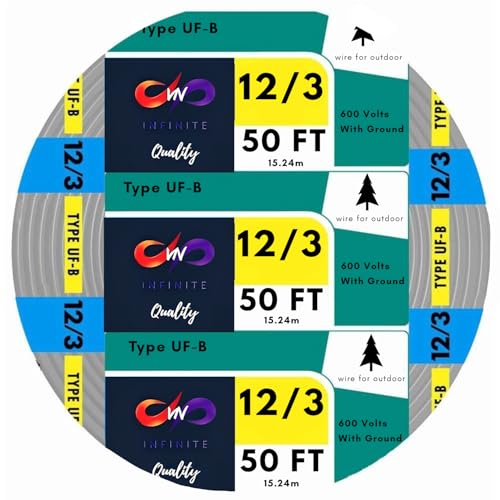
This VN Infinite cable is UF-B rated, meaning it has a solid PVC jacket rated for direct burial underground — no conduit required. The three 12 AWG copper conductors plus ground wire carry 20 amps at 600 volts, and the weatherproof jacket resists UV, moisture, and soil chemicals for outdoor feeder and branch circuits.
Real-world users have installed it for shed sub-panels, outdoor lighting, and pump circuits, reporting that the copper conductors strip cleanly and the jacket holds up during trench backfill. It is distinctly different from MC cable in that it lacks metal armor entirely — use it where physical protection from impact is not needed, like buried runs or indoor dry locations.
The 50-foot length is practical for reaching an average backyard shed or detached garage from the house panel. Note that UF-B must be buried at least 24 inches deep per NEC 300.5 if not in conduit, and it cannot be used in exposed interior locations where physical damage is possible.
Why it’s great
- Direct burial rated — no conduit needed underground
- UV-resistant PVC jacket handles sun and moisture exposure
- Full 12 AWG copper for consistent 20-amp capacity
Good to know
- Not metal-clad — no impact protection for exposed runs
- Requires 24-inch burial depth per NEC code
6. Woods 68580023 100′ 12/2 MC Alum Cable

This 100-foot Southwire spool is a 12/2 MC cable, meaning two insulated conductors plus a ground — ideal for standard 120-volt branch circuits where you only need one hot, one neutral, and a ground. It uses aluminum conductors inside lightweight aluminum armor, reducing the total weight to 10 pounds for the full 100-foot spool.
The 12/2 configuration works perfectly for dedicated outlet circuits, lighting branch runs, or feeder lines to sub-panels in outbuildings when paired with a separate ground rod. Users report the armor reverses off the spool smoothly and the cable pulls through studs without binding. The cost per foot undercuts local electrical supply houses, making it a strong option for budget-conscious long runs.
Remember that 12/2 does not give you the second hot leg needed for 240-volt equipment — if you need a dryer, EV charger, or welder circuit, move to the 12/3 options. Also, this cable cannot be buried directly; it must be run through PVC conduit for underground sections per local code.
Why it’s great
- Low per-foot cost for long 120V branch runs
- Reverses off the spool with minimal tangling
- Lightweight aluminum armor reduces installation fatigue
Good to know
- 12/2 cannot support 240V circuits
- Requires conduit for underground sections
7. Southwire Armorlite 12/3 MC Cable 250 ft Coil
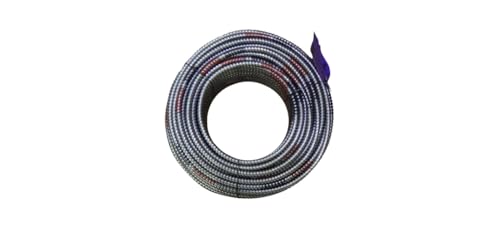
At 250 feet with copper conductors, this Southwire Armorlite coil is the largest spool available for serious whole-house rewiring or multi-unit commercial work. It uses soft-drawn copper THHN wire in black, red, white, and green — the same high-quality inner conductors as the 100-foot version — with 600-volt, 20-amp ratings throughout.
Contractors consistently note that buying this single 250-foot coil costs less per foot than buying three separate 100-foot rolls from local retailers. The aluminum interlocking armor keeps weight manageable at 12 pounds, and the cable feeds smoothly from a spool cart or wire reel. Two verified electricians reported using it for rewiring 1970s homes with exposed stud bays, running multiple circuits from one coil without leftover short pieces.
The coil does not come on a traditional spool with a center hole — it ships as a taped coil that you must pull from the inside to prevent tangling. Setup takes extra time, and the coil is heavy enough to need two hands. If your project demands less than 100 feet, the smaller spool is more practical.
Why it’s great
- Lowest per-foot cost for 12/3 copper MC cable
- Soft-drawn copper bends easily in tight joist bays
- 250 feet covers multiple circuits or a full house branch run
Good to know
- Taped coil must be carefully unspooled to avoid kinking
- Overkill for single-room or single-appliance circuits
FAQ
Can 12/3 MC cable be used for direct burial underground?
What is the difference between 12/2 and 12/3 MC cable?
Do I need anti-short bushings for 12/3 MC cable terminations?
How do I strip 12/3 MC cable without damaging the inner wires?
Final Thoughts: The Verdict
For most users, the 12/3 mc cable winner is the Southwire Armorlite 100 ft because it delivers solid copper conductors, a full 100-foot spool, and UL listing for air-handling spaces at a per-foot cost that beats local supply houses. If you want a compact starter spool for a single small circuit, the Southwire 68583421 25 ft is your most affordable option. And for large-scale projects where per-foot price matters most, nothing beats the Southwire 250 ft coil on unit cost.